
Every November, thousands of stores do the same thing. They pick a number, usually 20% or 25%, slap it on a banner, and email it to their whole list. Everyone gets the same code. Everyone gets the same cut into your margin.
That’s the laziest part of most Black Friday planning, and it’s also the most expensive. A real black friday discount strategy isn’t about picking one brave-looking number and hoping your margins survive. It’s about controlling your average payout while still making the offer feel exciting. Those are two different problems. A flat storewide code solves neither one well.
- The real problem with a flat black friday discount strategy
- The math behind weighted wheel odds
- Set your target average before you touch the wheel
- Sample configurations for different margin comfort levels
- Perceived value beats actual value, every time
- Adjusting odds while the sale is live
- The mistake almost everyone makes
The real problem with a flat black friday discount strategy
Here’s the thing about a flat 20% off code: everyone who was going to buy anyway also gets 20% off. Say a candle shop doing a few hundred orders a month has a customer with a $60 cart sitting there, ready to check out at full price. That code just handed over $12 for nothing. You didn’t convince anyone. You just gave away margin nobody asked for.
And it trains people. Run a 25% storewide sale every November and by year three, your regulars aren’t checking your site in October. They’re waiting for the email. That’s not loyalty. That’s a habit you built yourself, on your own dime.

Discounts aren’t the problem here. A single flat number applied to every visitor is just a blunt tool for a problem that needs more precision.
The math behind weighted wheel odds
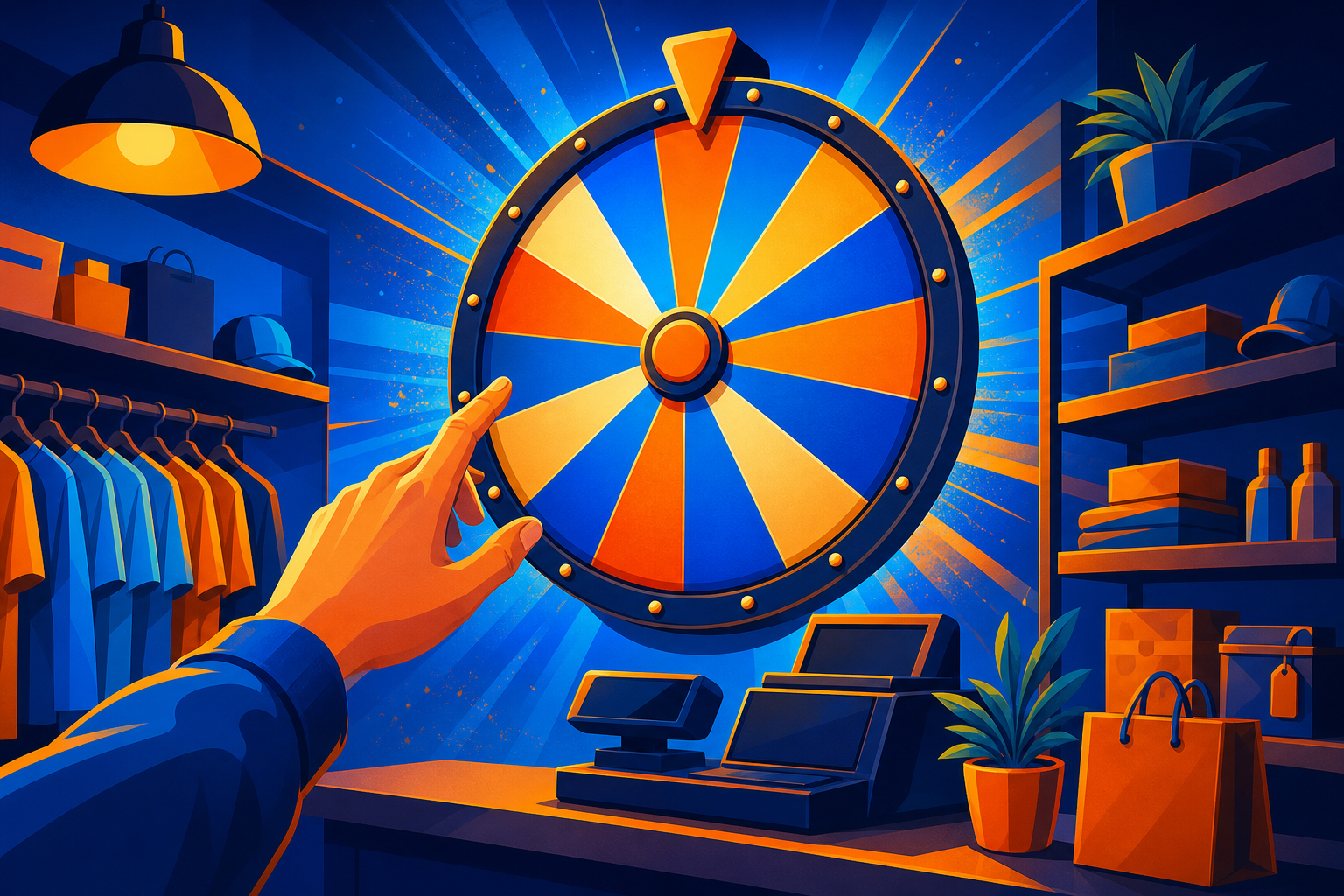
A spin-to-win wheel can advertise “win up to 50% off” on the popup itself, which is a genuinely exciting headline. What actually gets handed out depends entirely on how you weight each segment.
Say you build a wheel with six segments: 5% off, 10% off, 10% off, 15% off, 20% off, and 50% off. Give each segment equal odds (one in six) and your average payout lands around 18%. Not terrible, but not far off from just running a flat 20% code.
Now weight it differently. Give the 5% segment a 40% chance of landing, the two 10% segments a 25% chance combined, 15% a 15% chance, 20% a 12% chance, and that flashy 50% a 3% chance. Run the numbers and your average payout drops to somewhere around 11-12%, while your popup still gets to say “up to 50% off” in bold letters.
The prize on the wheel that gets the most attention is usually the one that gets handed out the least.
That’s the whole trick. Shoppers remember the biggest number they saw, not the average. Nobody walks away from a wheel calculating your blended discount rate. They remember whether they won something, and what it felt like to win it.
Set your target average before you touch the wheel
Here’s where most merchants skip a step. They open their popup app, start dragging prize tiles around, feel generous because it’s launch week, and end up with a wheel that averages out to more than their old flat sale. Then BFCM ends and they wonder where the margin went.
Work backward instead.
That last step matters more than it sounds. Building the wheel first and doing the math second is how stores end up accidentally generous.
Sample configurations for different margin comfort levels
There’s no single right setup here. It depends on your margins and how nervous you are about BFCM volume. A few starting points:
| Setup | Best for | Watch out |
|---|---|---|
| Conservative (target ~8-10% average) | Low-margin categories, high order volume stores | Top prize needs to feel genuinely rare or shoppers get cynical about ever winning it |
| Balanced (target ~12-15% average) | Most mid-size Shopify and WordPress stores running a normal BFCM push | Easy to drift higher if you add “just one more” high-value segment at the last minute |
| Aggressive (target ~18-20% average) | Stores clearing old inventory or newer stores trying to build an email list fast | You’re close to flat-discount territory again, so make sure the game itself is adding real conversion lift |
We’d lean conservative or balanced for most stores. Aggressive setups can work, but only if you’re honest about why you’re choosing one. Clearing inventory is a fine reason. Panic, three days before Black Friday, is not.
Perceived value beats actual value, every time
This is the part people underestimate. A shopper who spins a wheel and wins 15% off feels like they earned something. A shopper who just types a code they saw on a banner feels nothing. Same discount, completely different emotional outcome.
One spin. One prize. Good through Cyber Monday only.
Notice the headline never claims everyone gets 50%. It doesn’t have to. “Up to” is doing a lot of honest, legal, effective work there.
Adjusting odds while the sale is live
Don’t treat your wheel settings as a one-time setup you build on the Monday before Thanksgiving and then ignore. If redemptions are coming in lower than your target average, you have room to loosen the odds slightly on the bigger prizes to push conversion. If redemptions are running hot and your average payout is drifting past target, tighten them back.
This is one place where a flat code genuinely can’t compete. You can’t un-discount an order that already used BF20. But you can adjust wheel weighting hour by hour as the campaign runs, which is a real advantage, not a marketing line.
The mistake almost everyone makes
We see this constantly: a store gets excited building their wheel, adds a 50% segment, then adds a 40% segment too “just in case people think the wheel is rigged,” then bumps the 10% segment up to 15% because it felt stingy. By the time they’re done, four of six segments are high-value, and the average payout is worse than if they’d just run a flat sale.
Fewer, well-weighted segments tend to outperform a crowded wheel. That logic applies doubly during BFCM, when traffic, and prize payout volume, are both higher than any normal week.
It’s also worth thinking about when the wheel shows up in the first place, since timing and odds are two different levers on the same offer. That’s a separate topic, and a longer one than this post has room for.
Frequently asked questions
What’s a reasonable average discount for a Black Friday wheel?+
There’s no universal number, it depends on your margins, but most mid-size stores land somewhere between 10% and 15% blended average, even while advertising a much bigger top prize.
Should every visitor get a prize when they spin?+
Most stores do give everyone something, even if it’s small, since a wheel that sometimes gives nothing tends to frustrate people and can hurt email opt-in rates.
Can I change the odds after Black Friday starts?+
Yes, that’s one of the advantages of a wheel over a flat code. You can tighten or loosen prize probabilities mid-campaign based on how your actual average payout is tracking.
Does a gamified wheel actually convert better than a flat discount banner?+
We can’t give you a universal number since results vary by store and traffic, but the core idea, that an earned-feeling prize creates more excitement than a static code, is the whole reason gamified popups exist.
Before you finalize anything this year, do the blended-average math on paper first. It takes ten minutes, and it’s the difference between a wheel that feels generous and one that actually is.